Table of contents
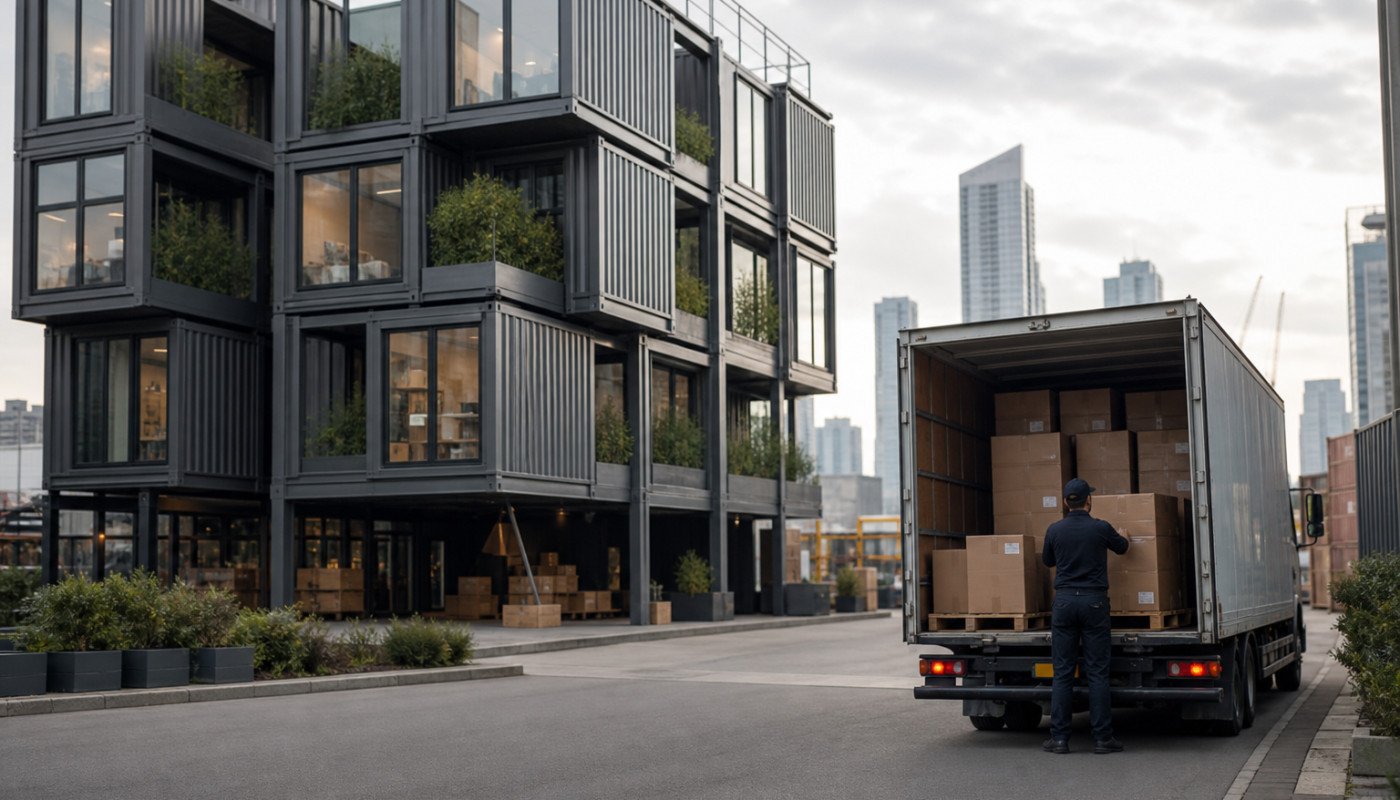
Ports are spilling into cities, and cities are pushing back. From Los Angeles to Rotterdam, congestion, land scarcity, and tightening emissions rules are forcing logistics players to rethink the “last 50 miles” between terminal gates and urban consumers, and one of the quietest shifts is happening inside the box itself. Container architecture, once synonymous with standardized steel rectangles, is evolving into modular, shock-resistant, and automation-ready platforms that make urban distribution faster, cleaner, and easier to control.
From port bottlenecks to city constraints
Urban logistics has entered an era where the limiting factor is no longer global shipping capacity alone, but the ability to move goods through dense metropolitan corridors without gridlocking them. In the United States, the Los Angeles and Long Beach port complex handled close to 16 million TEUs in 2023, according to port statistics, and while that was below the pandemic peak, the broader lesson remained: a surge at the waterfront quickly becomes a surge on freeways, rail ramps, and warehouse districts. In Europe, the Port of Rotterdam processed roughly 13.4 million TEUs in 2023, and the same pattern repeats around major gateways, with road congestion and nitrogen oxide limits shaping what is feasible inside and near cities.
The pressure is amplified by policy. Low-emission zones are expanding across Europe, and urban freight is increasingly targeted because it is visible, noisy, and politically sensitive. London’s ULEZ, Paris’s tightening Crit’Air restrictions, and similar measures in German cities all tilt the playing field toward fewer trips, higher load factors, and cleaner vehicles, yet those goals collide with consumer expectations of next-day delivery. The result is a practical question that executives now ask more often than they talk about “supply chain resilience” in abstract terms: how do you move the same volume with fewer kilometers, less curb time, and fewer handling steps?
This is where container architecture becomes urban policy in metal form. Traditional ISO containers are optimized for ocean transport and intercontinental interchange, not for repetitive shuttles between micro-fulfillment nodes, consolidation centers, and retail backrooms. Urban distribution punishes weak points: constant braking and acceleration, tighter turning radii, frequent transfers between vehicle types, and more “touches” per shipment. A container that survives a transpacific crossing may still be inefficient in a city because it is too rigid in format, too slow to load and unload, or poorly adapted to automation and real-time tracking.
Logistics operators are therefore redesigning the unit of movement itself, not just the route. Instead of asking only where to build the next warehouse, many are asking how to standardize smaller, modular load units that can flow between trucks, vans, cargo bikes, and automated handling systems, and how to do so without losing the durability and interoperability that made containerization revolutionary in the first place.
Modularity becomes the new competitive edge
Can a container be both standardized and customizable? That is the tension driving a wave of engineering changes that look incremental on paper, yet compound into significant productivity gains on the street. Modular load platforms, swappable frames, and multi-purpose skids are increasingly used to reduce dwell time at hubs, and to make cross-docking less labor-intensive. In an urban context, minutes matter: if a vehicle spends an extra 12 minutes waiting for a pallet rework, that delay ripples into missed delivery windows, double-parking, and penalty fees, and it also erodes the promise of route optimization software that assumes predictable service times.
The economics are stark. Road freight is still the dominant mode for city supply; in the European Union, road accounts for the clear majority of inland freight transport, and urban deliveries remain labor-heavy because automation is harder to deploy on sidewalks than in greenfield warehouses. As wages rise and hiring stays tight in many markets, logistics firms are chasing “hands-off” minutes, the small slices of time saved through better unit loads, easier securing, and faster transfers. A modular architecture can turn a chaotic set of boxes into a repeatable process: consolidate upstream, lock the load into a stable carrier, and then move it through the city with fewer interventions.
That is why the conversation is shifting from the container as a passive shell to the container as an active interface. Modern units are designed with compatibility in mind: forklift pockets placed for tighter maneuvering, tie-down geometry that reduces rework, and integrated shock and vibration protection that prevents damage on pothole-heavy routes. For sectors such as electronics, healthcare, and high-value spare parts, damage rates can quietly eat margins; packaging alone cannot solve the issue if the load carrier transmits repeated micro-impacts through the last mile.
One concrete expression of this trend is the renewed focus on specialized carriers such as Skids, which can act as robust, repeatable interfaces between handling equipment and the goods themselves. The point is not branding, it is physics and process control: a stable platform can cut down on load shifts, speed up transfer operations, and support modular systems where units are assembled, broken down, and reassembled across a city network without compromising safety or traceability.
Automation-ready units change the workflow
The biggest gains often come when container design and facility design finally speak the same language. Automation has spread quickly in large distribution centers, but urban logistics facilities are smaller, more constrained, and often built into existing real estate. That makes the margin for error thinner: if a load unit is slightly misaligned, an automated guided vehicle may stall, and if a barcode is damaged, a sorting line may reject the shipment. Automation-ready container architecture aims to reduce those friction points by making units more legible to machines, and more consistent in how they are handled.
In practice, that means design features that are not glamorous but are decisive, such as standardized lifting points, predictable center-of-gravity behavior, and surfaces that tolerate repetitive mechanical contact. It also means embedding identification in ways that survive urban wear, from rain exposure to repeated scraping at loading docks. As retailers and parcel networks push micro-fulfillment closer to consumers, they are relying on higher-frequency shuttles between regional hubs and city nodes, and those shuttles benefit from load units that can be dropped into a workflow with minimal human correction.
There is also a safety and compliance dimension. Urban freight increasingly operates under stricter rules on working time, curbside operations, and site safety. A unit that is quicker to secure, easier to verify, and less prone to tipping reduces not just delays but incident risk. That matters because the cost of a single injury, or a single damaged batch of temperature-sensitive goods, can dwarf the cost difference between a basic load platform and an engineered one. Insurers and large shippers are paying attention; the “hidden” costs of urban distribution are moving from back-office spreadsheets into procurement requirements.
Automation-ready architecture is not limited to warehouses. In some cities, planners are experimenting with urban consolidation centers and logistics micro-hubs, and the operational promise depends on smooth transfers between modes. If a carrier can move efficiently from a truck to a smaller vehicle without re-picking individual cartons, it reduces the number of handling steps, and it also reduces the chance of errors. That is exactly the kind of improvement that scales, because it compounds across thousands of daily movements rather than relying on a single dramatic technology leap.
Greener last miles, fewer wasted kilometers
Decarbonizing urban logistics is no longer a public-relations gesture, it is becoming a license to operate. The International Energy Agency has repeatedly underlined that transport is a major source of energy-related CO2 emissions globally, and cities are reacting with practical restrictions that reshape fleets and networks. Electrification helps, but electrifying inefficiency is still inefficiency: if vehicles are poorly loaded, if routes require repeated returns to depots, and if loads are frequently reworked, the emissions and costs remain higher than they need to be.
Container architecture affects emissions in a simple way: it influences how many trips are required to move a given volume, and how much time vehicles spend idling or circling. Better modularity can support consolidation, which increases load factors, and it can also enable “milk-run” patterns where one vehicle serves multiple stops with predictable handling times. In a city, predictability is a climate tool because it reduces buffer kilometers. If carriers reduce damage and shrink the need for replacement shipments, that too has a carbon impact, one that rarely shows up in glossy sustainability reports but shows up in real fuel consumption.
There is also an infrastructure angle. Cities do not have infinite space for logistics, and land near consumers is expensive. Smarter load units can reduce the footprint required for staging and sorting because they make flows more orderly. That means fewer square meters devoted to buffers and rework zones, and more throughput from the same facility. In regions where industrial vacancy rates are tight, this is becoming an operational advantage: the fastest-growing operators are often the ones that can do more inside the same walls, rather than those that can simply lease additional space.
The transformation, then, is not that containers are suddenly fashionable, it is that they are being redesigned as instruments of urban efficiency. Standardization made globalization possible; modularity and automation-readiness are now being asked to make dense-city logistics tolerable. For operators, the strategic bet is clear: invest in the architecture of movement, and the network becomes easier to decarbonize, easier to staff, and harder for competitors to replicate quickly.
Planning the shift without disrupting operations
Switching load units is not a cosmetic change, and the risk is real: a new architecture can create incompatibilities with forklifts, docks, shelving, and vehicle bodies if it is adopted hastily. The most successful transitions tend to start with a clear diagnostic of pain points, whether that is damage on specific routes, bottlenecks at transfer points, or chronic under-utilization of vehicle space. From there, pilots focus on one lane or one product family, and measure time per stop, damage rates, and handling touches, because these metrics reveal whether the new system is truly improving the urban workflow.
Procurement teams increasingly ask for evidence rather than promises. They want to know how a carrier behaves under vibration, how it tolerates repeated cycles, what the maintenance profile looks like, and whether it integrates with tracking and identification systems. They also want to understand the operational trade-offs: a more robust platform may weigh more, yet still reduce emissions if it prevents extra trips and product losses. The evaluation, in other words, has moved beyond upfront unit cost to total cost per delivery, and that aligns with the way urban logistics is regulated, where externalities like congestion and air quality are becoming internal costs through fees and restrictions.
Finally, the human factor matters. Drivers, dock workers, and site managers will adopt a new load architecture faster if it makes their day easier, not harder. Urban logistics runs on tight schedules and improvisation; equipment that reduces improvisation, and makes outcomes more repeatable, is more likely to stick. In a sector obsessed with software dashboards, it is a reminder that physical design still decides whether the plan survives contact with the street.
What to budget, what to ask, where to start
Start with a pilot lane, a clear KPI set, and a realistic budget that includes training and minor site adaptations, because the return typically comes from fewer touches and fewer incidents rather than from a single dramatic saving. Ask suppliers for lifecycle data, repairability, and compatibility with your handling equipment. Look for local or national decarbonization aids, and schedule changes outside peak periods to avoid disrupting service.
Similar

Virtual Reality: An Untapped Resource in Mental Health

How Free AI Chat Interfaces Are Revolutionizing Online Interactions

Revolutionizing Fitness: The Latest Wearable Tech Gadgets

Breaking Boundaries with Digital Art: A New Era
